
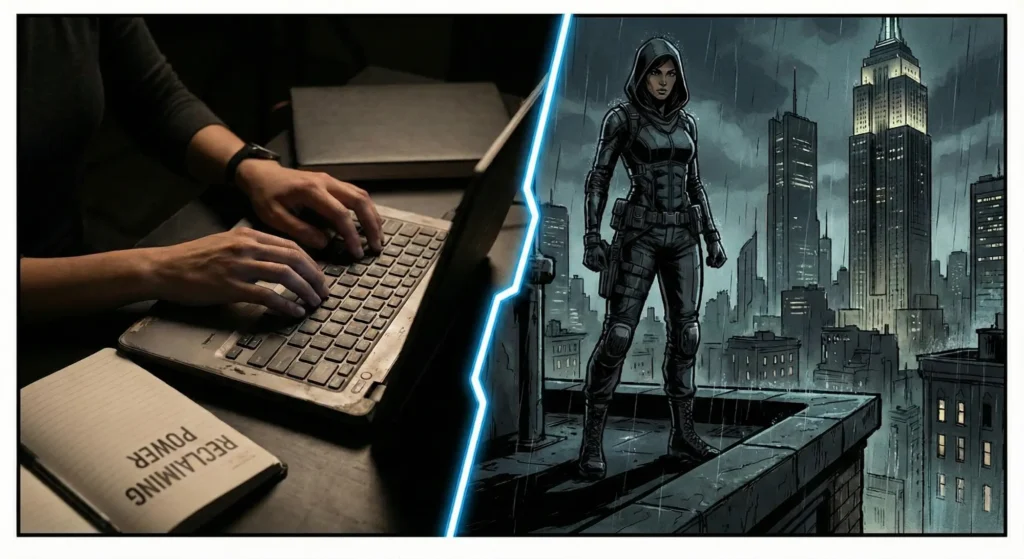
I CAN RELATE to the suffocating weight of feeling powerless. For a long time, I lived under the sway of someone whose influence I should have questioned much sooner.
I spent years taking shit from those who only wanted to control me for their own warped purposes. I became an expert at shrinking myself, folding my personality into smaller and smaller shapes to fit into the boxes they built for me.
It is a terrifying thing to look in the mirror and realize you have unwittingly agreed to wear chains. You wonder where the person you used to be has gone.
But it took me a while to wake up to the most important truth of all: the power was never truly gone. It was just dormant. It was in me all along, waiting for a spark to ignite it.
The creative transmutation of rage
To express that power, I didn’t just scream into the void. Screaming is cathartic, but it dissipates into the air. I wanted something more permanent.
I wanted to take the leaden weight of my trauma and transmute it into gold—or perhaps, into steel. So, I created a weapon.
I created Nadine Singh.
Writing is often described as a gentle art, a practice of muse and melody. For me, it is combat. It is the arena where I can finally hit back.
Nadine is the manifestation of the rage and resilience that comes after survival. Her story mirrors the darkness of oppression but flips the script on the victimhood.
The architecture of a survivor
Nadine is not a hero in the traditional sense. She doesn’t wear a cape, and she doesn’t follow the rules of polite society. She is a response to a broken world.
Her origin story is one of profound abandonment. Abandoned before she could walk, she didn’t know the warmth of a family or the safety of a home.
Instead, she grew up in a rigid, authoritarian system. She took orders to “be good” from a sadistic Mother Superior who believed that obedience was godliness.
This is a dynamic I understand intimately.
The demand for unquestioning obedience is the hallmark of every tyrant, whether they run a convent, a cult, or a corporation.
The breaking point
For years, Nadine endured. She took the abuse. She tried to play by the rules that were rigged against her. But every human soul has a limit.
There is a precise moment when the pressure becomes too great, and the vessel either cracks or explodes. For Nadine, something inside her finally snapped.
She realized that the rules were not designed to keep her safe; they were designed to keep her small. So, she didn’t just leave; she escaped.
She tore herself away from the structure that defined her. It was a violent, desperate act of self-preservation.
Her rebellion started small—robbery, a desperate clawing for survival on the streets. But as she navigated the underworld, she found her true calling.
Ending the borrowed time
Writing Nadine allows me to explore a world where justice isn’t delayed by red tape. In the real world, the bad guys often have better lawyers than the good guys.
In the real world, justice is often bought by the highest bidder or buried under procedural technicalities. But in my books, the gavel doesn’t fall; the hammer does.
Nadine exists to free the world of powerful men who think they can get away with anything. She hunts the untouchables.
She is the predator that the predators never saw coming. She moves in the shadows they created, using their own arrogance against them.
She is their worst nightmare. As Bane so eloquently said in The Dark Knight Rises:
“I am here to end the borrowed time you’ve all been living on.”
The mantra of the vigilante
That is Nadine’s mantra. It is the engine that drives the narrative. She isn’t just seeking revenge for herself; she is balancing the scales for everyone who has been silenced.
When she takes down a target, it is not an act of murder; it is an act of correction. She is fixing a glitch in the moral universe.
For a writer who spent years feeling helpless, there is a profound satisfaction in controlling the outcome. In my books, the bad guys don’t get a plea deal.
They don’t get to spin the narrative in the press. They get Nadine. And Nadine does not miss.
The mirror in the fiction
While Nadine Singh is a fictional character, she represents something very real to me. She is the avatar of my own emancipation.
Every time she outsmarts a villain, I am outsmarting the people who tried to control me. Every time she refuses to back down, I am reclaiming a piece of my own spine.
She is the hero inside all of us just waiting to be born. She represents the moment we decide to stop being victims of circumstance and start becoming agents of our own fate.
We all have a Mother Superior figure in our lives. It might be a boss, a partner, a system, or a shadowy influence we need to escape.
We all have a voice in our head telling us to sit down, shut up, and be grateful for the scraps we are given. Nadine is the voice that says, “No.”
Tearing off the chains
Writing these thrillers is my way of tearing off the chains of slavery I agreed to all those years ago. It is a declaration of independence, stamped in spiritual ink.
It is a reminder that while we cannot change where we started, we possess the absolute power to dictate how the story ends.
I cannot erase the years I lost to a high-control group. I cannot undo the psychological conditioning I endured. But I can decide what I do with the wreckage.
I can build a fortress. I can build a weapon. I can build a legacy of resilience.
Nadine Singh is not just a character in a book. She is the proof that I survived. She is the proof that they didn’t win.
And if you are reading this and feeling the weight of your own chains, remember: you can break them. You can write your own escape. You can be the hero who ends the borrowed time.
***
About the Author
Michael J. Mallen is a psychological thriller author and a survivor of coercive mind control. He draws on his real-world experience with dark psychology to deconstruct predatory behavior in his blog and his fiction. He is the author of the Nadine Singh Thrillers.
Curious how a cult leader operates?