
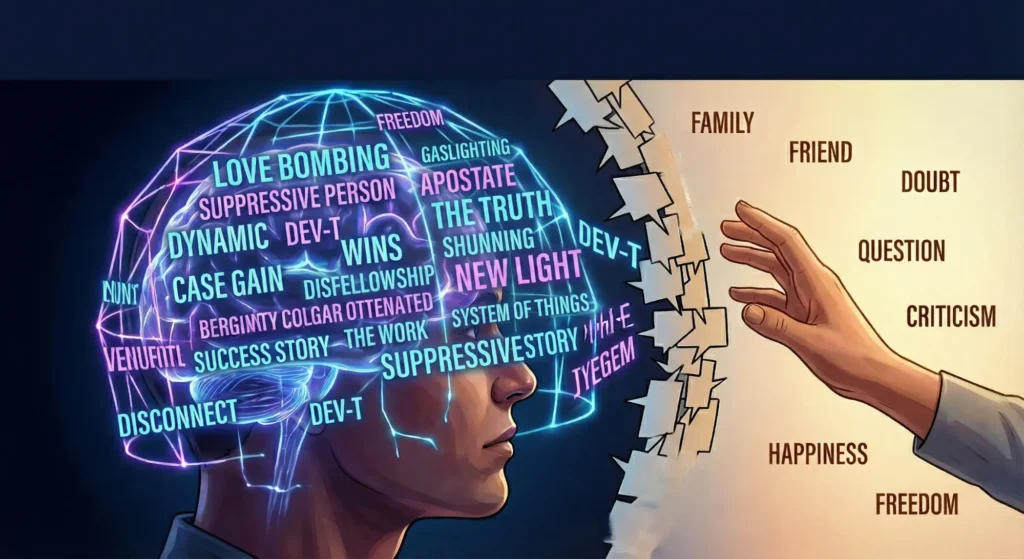
LANGUAGE IS THE operating system of human thought. It’s how we categorize our experiences, express our emotions, and connect with reality. But what happens when someone else gains administrative control over that operating system?
When a person enters a high-control group—often termed a cult—they aren’t just adopting a new set of beliefs; they are stepping into a new linguistic reality. One of the most insidious and effective tools in the authoritarian arsenal is “loaded language.”
It’s a process of slowly redefining vocabulary, creating an internal “groupspeak” that isolates members, dictates how they process information, and ultimately, controls how they think.
Here is how groups steal language to build walls around the minds of their members.
The Slow Drip of Indoctrination
Nobody joins a cult knowing it’s a cult. They join looking for answers, community, or self-improvement. In the beginning, the introduction of new terminology feels exciting, almost academic. It feels like being initiated into higher knowledge.
The group introduces specialized terms for complex human emotions or societal problems. Suddenly, your past trauma isn’t just “baggage”; it’s a specific, actionable item on the group’s curriculum. Your confusion isn’t just confusion; it’s a labeled state of mind that only the group’s technology can fix.
This new vocabulary is presented as superior—a precise scientific or spiritual toolset that the “unenlightened” outside world lacks. Learning this “secret code” triggers a dopamine hit of belonging. You are now an insider.
The Mechanics of “Groupspeak”
Over time, this specialized vocabulary replaces normal speech. This happens through several linguistic tricks common across various high-control movements:
- Redefining the Ordinary: Common words are stripped of their usual meaning and assigned a new, group-specific definition. A verb might be twisted into a noun to sound more technical. In Scientology, for example, the word “dynamic” is repurposed to describe compartments of survival impulses. In other groups, words like “purity,” “truth,” or “accountability” are warped to mean blind obedience to leadership.
- The Fabrication of Complexity: Groups often invent entirely new, sometimes nonsensical words to describe negative states of mind or perceived obstacles.
Scientology is famous for this, using made-up terms like “enturbulation” (agitation or confusion) or acronyms like “dev-t” (developed unnecessary traffic/bother). By creating complex words for simple problems, the group makes the member feel dependent on their complex solutions.
- The Thought-Terminating Cliché: These are catchy, definitive-sounding phrases designed to stop critical thinking in its tracks. If a member raises a legitimate doubt, they are met with a canned response like, “Doubt is just the devil whispering,” or “You are just resisting your own growth.” These phrases don’t answer the question; they shame the questioner into silence.
Creating the “Us vs. Them” Reality
The most damaging function of loaded language is the creation of an unbridgeable chasm between the group and the rest of the world.
To maintain control, a high-control group needs an external enemy. History shows us extreme examples, such as how the Nazis used dehumanizing language to categorize Jews as the source of all societal ills.
Modern high-control groups operate similarly. They have specific, loaded terms for anyone who opposes them or even just fails to support them.
In Scientology, the ultimate boogeyman is the “Suppressive Person” (SP)—the hidden source of all things gone wrong in a member’s life. Other groups may label critics as “apostates,” “agents of Satan,” or “suppressors.”
Once someone is tagged with this loaded label, the solution is pre-programmed: disconnection. You cannot rationalize with an SP; you must cut them out to protect your own progress. Language becomes the sword used to sever ties with family and friends.
Redefining Success
Perhaps the most surreal aspect of groupspeak is how it redefines happiness. In many of these groups, success is not measured by tangible life improvements, but by adherence to the group’s methods.
Members are encouraged, sometimes pressured, to share public “success stories.” These aren’t necessarily about getting a promotion or reconciling a relationship; they are often testimonials praising the group’s leader or doctrine for a perceived internal shift.
A member stands up and uses the group’s jargon to describe how a recent expensive course gave them incredible “wins” or allowed them massive “case gain.” The other members applaud enthusiastically.
This applause validates the use of the language. The member learns that to be accepted and praised, they must interpret their reality through the group’s lens and speak using the group’s words. They are trained to act happy in the specific way the group demands.
The Burden of the “Wog”
Eventually, the loaded language becomes so normalized that the member struggles to communicate with outsiders. The outside world—often referred to with derogatory, dismissive terms like “wogs” (in Scientology), “worldly people,” or “the asleep”—is seen as dangerous, ignorant, and unenlightened.
When a deeply indoctrinated member has to speak to a non-member, they must perform exhausting mental gymnastics to translate their thoughts back into plain English. They have to code-switch constantly. This mental effort is draining, further incentivizing them to stay within the comfortable bubble of the group, where everyone speaks the same “truth.”
Breaking the Spell
The tragic reality of loaded language is that it outlasts membership in the group. When someone finally manages to physically leave a high-control group, their mind is still running on the group’s operating system.
Ex-members often report that it takes years to rid themselves of the reflexive internal vocabulary.
They might feel a flash of guilt and hear a “thought-terminating cliché” in their head when they criticize their former leader. They might struggle to describe sadness without using a made-up cult word.
Deprogramming from a high-control group is largely a process of reclaiming language—relearning how to speak, think, and feel in their own words, rather than the stolen words of their abusers.
***
About the Author
Michael J. Mallen is a psychological thriller author and a survivor of coercive mind control. He draws on his real-world experience with dark psychology to deconstruct predatory behavior in his blog and his fiction. He is the author of the Nadine Singh Thrillers.
Curious how a cult leader operates?